Key takeaways
- Manual compliance processes fail in enterprise SaaS because the work scales with headcount and framework count, and buyers now demand continuous, current proof that controls operate as designed.
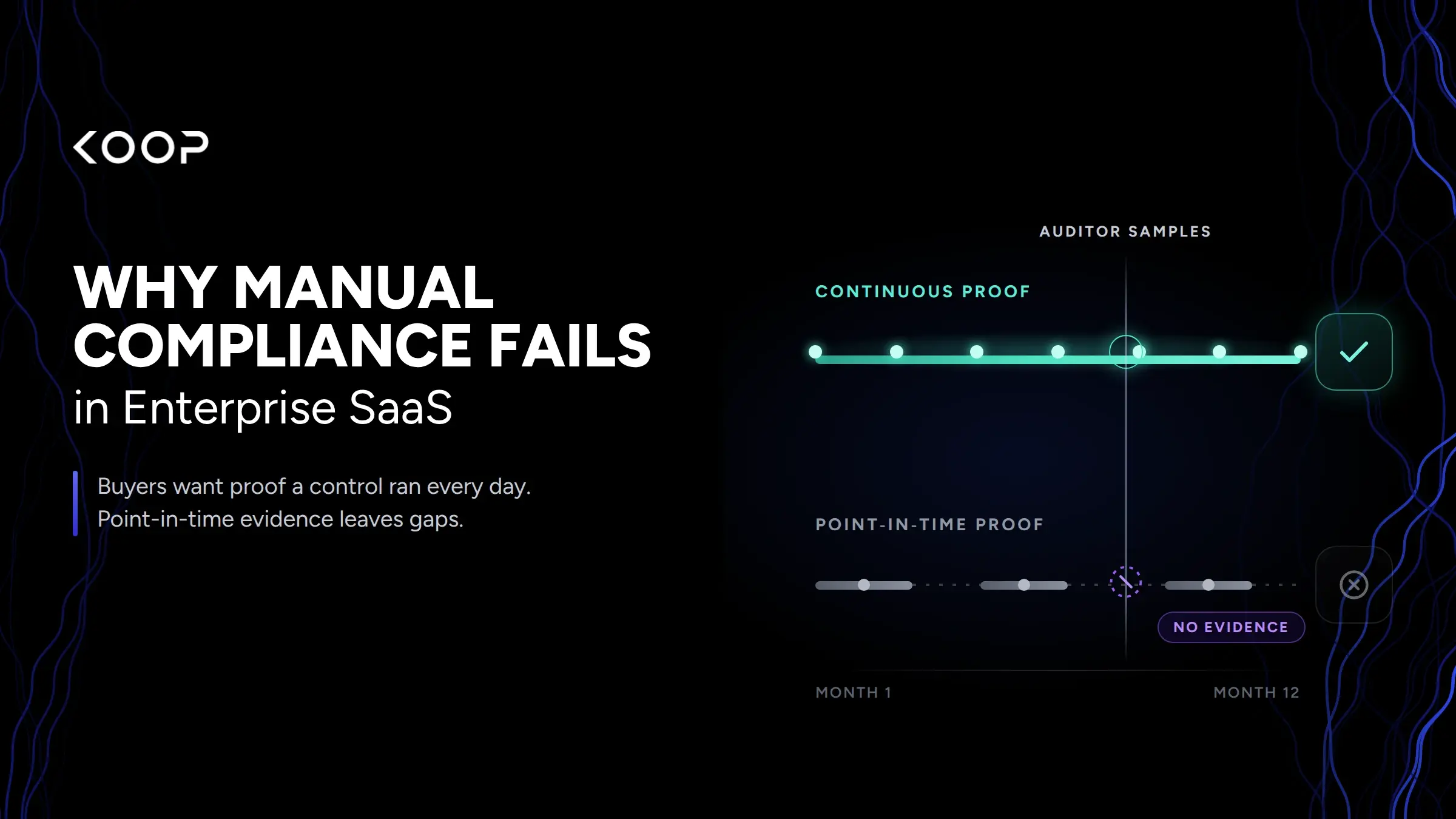
- Point-in-time evidence goes stale between audit windows, creating control drift that surfaces during customer security reviews,
- Compliance ownership splinters across four or more teams, and accountability for each requirement falls through the gaps.
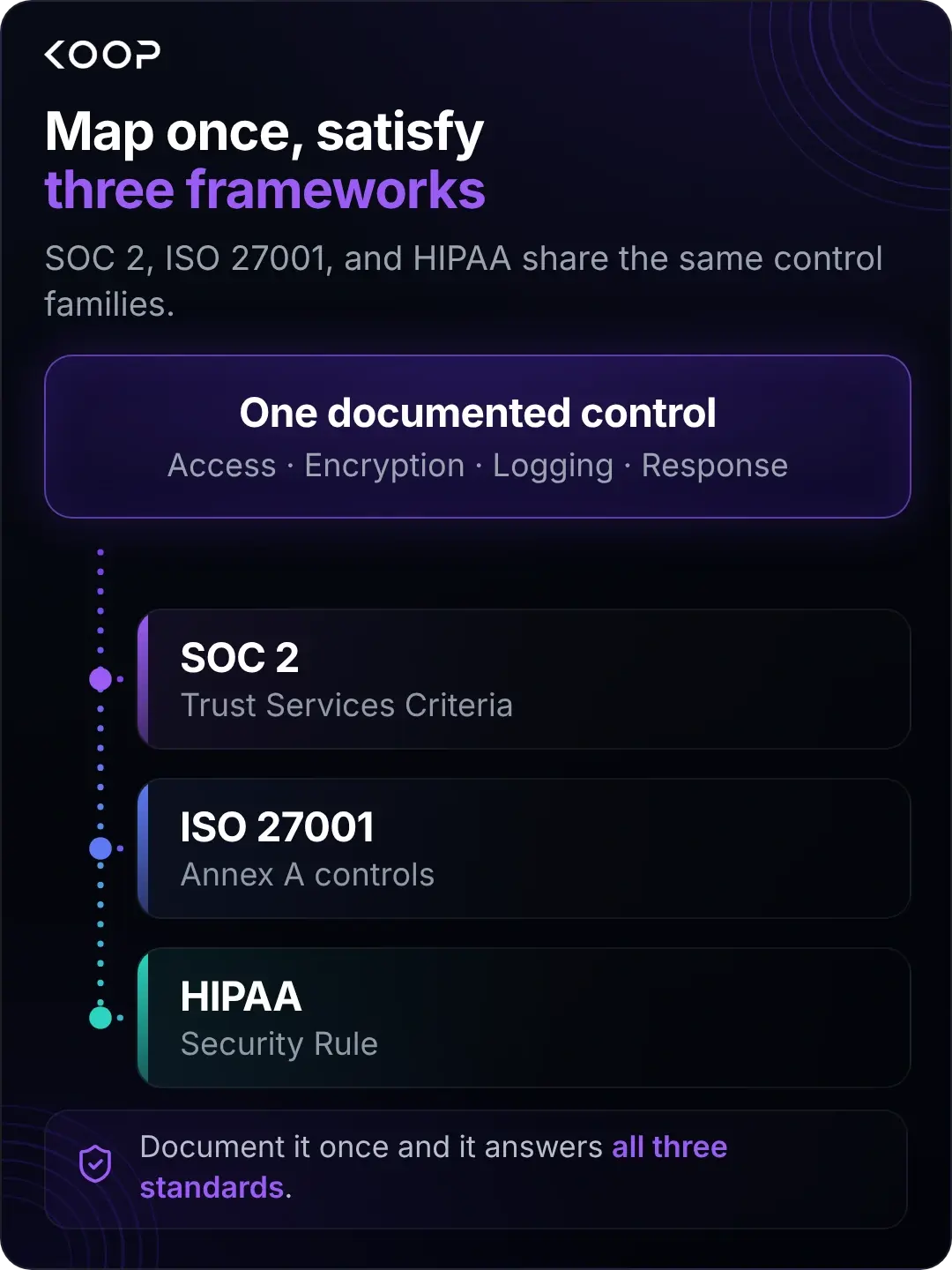
- Overlapping frameworks multiply duplicate work when each control is documented separately for SOC 2, ISO 27001, and HIPAA.
- Automated monitoring, centralized requirements, and expert support convert compliance into a revenue enabler.
Enterprise SaaS deals stall at the compliance step when spreadsheet-and-email workflows fall behind the evidence enterprise buyers ask for. A control verified once in a quarterly review looks current on paper, yet the buyer's security team wants proof that it operated every day of the audit period. That gap between a point-in-time snapshot and continuous proof widens with each new deal, each new framework, and each new engineer added to the team.

What manual compliance processes actually cost
Manual compliance work costs engineering hours, deal cycle time, and audit readiness. Four drivers account for most of the load:
- Evidence collection: Preparing an audit by hand pulls dozens of hours of screenshots, exports, and records from across the tool stack.
- Control monitoring: In-house security and compliance staff are a standing cost: the U.S. Bureau of Labor Statistics put the median wage for information security analysts at $124,910 in May 2024, and most organizations take eight months or more to reach initial SOC 2 attestation
- Questionnaire response: Each security questionnaire pulls in security, IT, engineering, compliance, and revenue operations, and a company closing 200 deals a year absorbs that coordination repeatedly, since large vendors receive dozens to hundreds of questionnaires annually. Standardized assessments are extensive: the widely used CAIQ maps a full set of yes-or-no controls to the Cloud Security Alliance’s Cloud Controls Matrix, spanning encryption, access management, and business continuity.
- Audit preparation: Reconstructing a full evidence trail right before fieldwork turns every audit into a scramble, since hand-kept records rarely match the periods an auditor samples
Buyers keep expanding these assessments as supply chain risk grows. The Verizon 2024 Data Breach Investigations Report found that 15% of breaches involved a third party, such as a software supply chain or hosting provider, a 68% rise over the prior year.
Manual vs. automated compliance
The table below sets the manual approach against an automated equivalent across the four tasks that consume the most time:
A unified compliance platform reduces that operational load by centralizing evidence, monitoring, and requirements in one place. Teams that want to size the spend before committing can model it with a compliance budget calculator.
The Failure Points in Manual Compliance Processes
Manual compliance work breaks in a few predictable places, each tied to a stage in the enterprise sales cycle.
The SOC 2 Observation Period
A SOC 2 Type II report requires that controls operate effectively across an observation period of six to twelve months, and auditors sample specific days, weeks, and months within that window to confirm continuous operation.
The AICPA's 2017 Trust Services Criteria set the detection and monitoring requirements in Common Criteria CC7.1 and CC7.2, cataloged in NIST's public crosswalk of the criteria, which auditors read as logs collected from in-scope systems, retained on a defined schedule, and reviewed with documented follow-up on alerts. A manual process captures evidence at the start and end of the period, and the gaps in between become audit findings.
Evidence drift between audit windows
A control configured correctly in January can be modified in March and left undocumented until the next review. The report still shows the January state.
Continuous monitoring sits inside the Detect function of the NIST Cybersecurity Framework 2.0, which defines it as a standing activity, and enterprise buyers now ask for evidence dated within the current period. A stale snapshot triggers follow-up rounds that add weeks to procurement. Recording control state as conditions change gives a buyer or auditor an accurate answer on the day they ask.
Fragmented ownership across teams
Compliance touches engineering, security, sales, and legal, and each team owns a slice of the evidence. When a questionnaire arrives, security pulls screenshots, engineering confirms configurations, legal reviews data processing language, and compliance cross-checks certifications.
The control set itself is large: NIST SP 800-171 Revision 2 defines 110 security requirements across 14 families, the version referenced by the current DFARS clause and CMMC Level 2, and each requirement needs an owner and evidence. Ownership sits in separate systems and separate heads, so answers drift out of sync bet but ween deals and the same question draws a different response each time. A Housekeeper AI agent assigns and completes these tasks in one system.
Questionnaire volume that outpaces headcount
Questionnaire load grows faster than the team answering it. Dedicated headcount spends hundreds of hours a year restating the same security posture in different templates.
The formats add friction of their own, since VSA, SIG, CAIQ, and custom enterprise spreadsheets each expect a different structure. Security questionnaire automation fills the common formats from a single library of approved answers.

How manual work slows enterprise deals
A questionnaire that sits unanswered for two weeks is a deal cooling in the pipeline, and an inconsistent response triggers another review round that pushes the close further out. The regulatory stack keeps adding sections to those questionnaires.
DORA, the EU's Digital Operational Resilience Act, entered application on 17 January 2025 and covers more than 22,000 financial entities along with the technology vendors serving them. Every rule that lands on a customer becomes a new question in the assessment they send.
Framework overlap turns one control into repeated work when each framework is documented on its own.
Framework overlap: Controls mapped once vs. repeated
SOC 2, ISO 27001, and HIPAA share control families across access management, encryption, and monitoring, so a single documented control can satisfy all three at once. The table below lines up those shared families:
Tracking requirements per contract keeps the sales team ahead of each buyer. Requirements management holds contractual obligations in one place, and a Trust Center lets buyers self-serve certifications, evidence, and insurance proof. The certifications map to what procurement asks for, including SOC 2, ISO 27001, and HIPAA.
What replaces manual compliance processes
Under an automated control model, evidence accumulates as operations run, and the same system that tracks controls also answers customer and vendor requirements from one place.
Continuous control monitoring
Continuous monitoring captures each control's status on a running basis, keeping evidence current through the full observation period.
Organizations using security AI and automation extensively contained incidents nearly 100 days faster and averaged $1.88 million lower breach costs, according to IBM's 2024 Cost of a Data Breach Report. That ongoing record also supplies the timestamped evidence auditors expect. Compliance certifications run on this model across more than 50 frameworks, with SOC 2 evidence collected continuously against the AICPA Common Criteria.
Centralized requirements and trust sharing
Centralizing requirements gives every team one source for what each contract obligates and what each buyer has already been told, holding answers steady from one deal to the next. Extending that visibility to vendors closes the third-party gap, since data spread across multiple environments raises both breach cost and containment time. The Cloud Security Alliance's CAIQ is one standardized format buyers often send.
Third-party risk management automates vendor onboarding and monitoring, and regulatory intelligence tracks upcoming rules so teams prepare before a new requirement reaches a contract.
Expert-in-the-loop where automation ends
Scoping an audit, responding to an exception, and mapping a novel contractual requirement to existing controls all benefit from expert review. Professional services pairs the platform with compliance specialists for exactly those decisions, so the program keeps moving when a question falls outside what automation can settle.
Building an automated compliance program
An automated compliance program starts with control mapping and evidence collection built into daily operations. Companies that implement controls inside their stack and maintain continuous monitoring report smoother audits and faster sales cycles. The control set grows with the business:
- Startup: Securing a first enterprise contract calls for SOC 2 and requirements management
- Growth: Scaling companies add ISO 27001, expanded contract compliance, and risk management advisory
- Enterprise: Companies past $100M in revenue run multiple frameworks, AI-driven automation, and employee training across teams
AI systems bring their own framework, ISO/IEC 42001 for AI management systems, which shares governance and monitoring controls with existing standards.
Koop's stage-based approach matches the control set to company size, and AI and Software 2.0 companies meet framework combinations from a single mapped control library.
Regulatory change reinforces the case for building this now. New rules keep expanding the evidence buyers request. A program built on continuous monitoring absorbs each addition as a new mapped control, and the existing evidence pipeline carries the extra requirement without new manual work. Compliance runs as an operating function that scales with each new obligation as it arrives.
How Koop turns compliance into an advantage
Koop runs compliance, security, and insurance on one platform, so go-to-market teams stop coordinating across separate vendors. The Housekeeper AI agent performs compliance tasks automatically, continuous monitoring keeps evidence audit-ready, and expert support handles the calls that need human judgment. Certifications, questionnaire responses, and insurance proof live in one system buyers can open on their own.