Key takeaways
- A SOC 2 Type 1 certification gives buyers auditor-verified proof that your security controls were suitably designed on the assessment date.
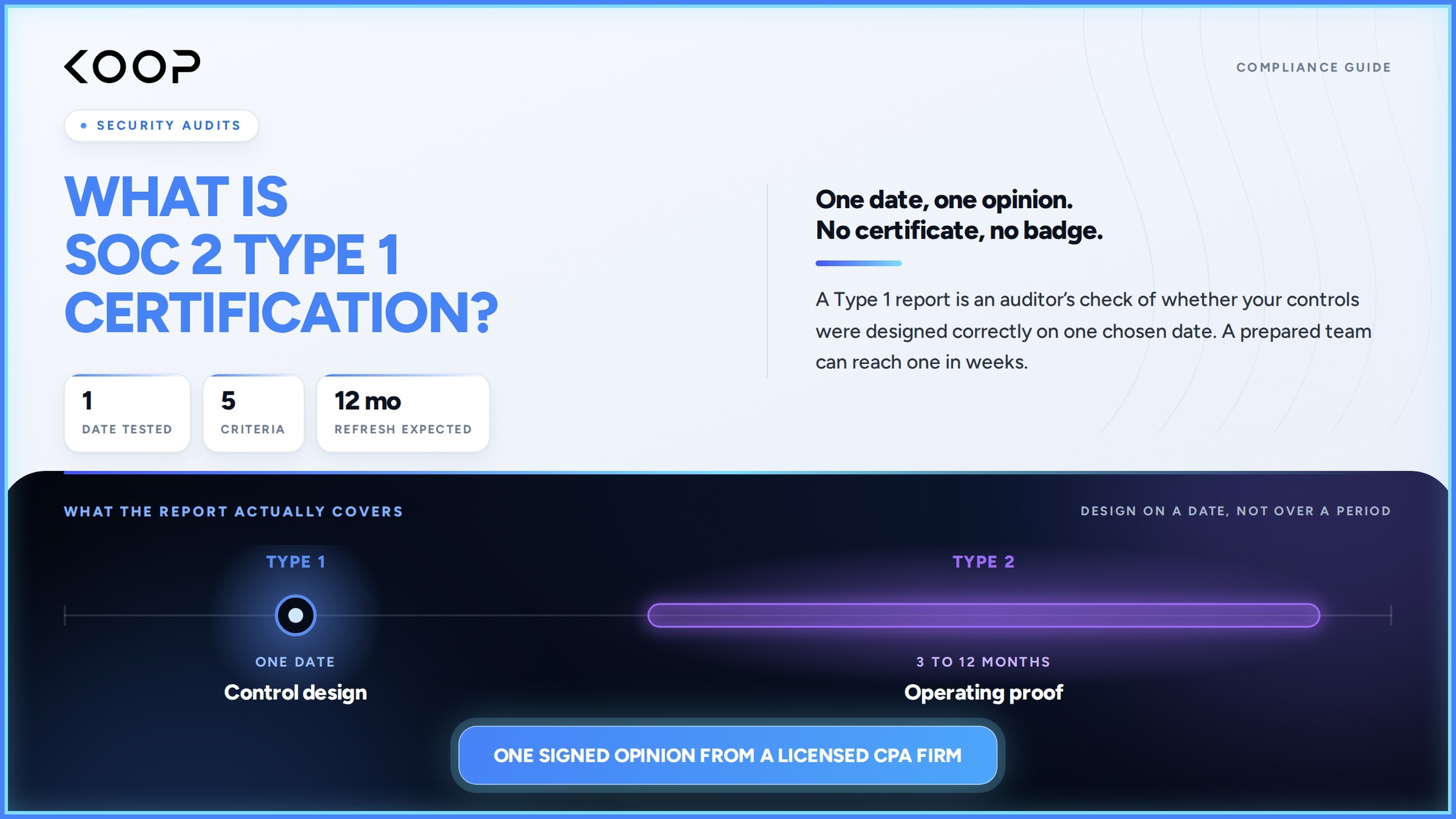
- A Type 1 report checks control design alone. A Type 2 report also verifies those controls stayed effective across a longer review period.
- Every SOC 2 report must include the Security category, and the other four Trust Services categories are optional depending on what you promise customers.
- Type 1 fieldwork is short, making it a quick way to satisfy a buyer's security request.
- A Type 1 report carries no formal expiration, and buyers generally expect a refreshed report each year.
For a service organization selling to enterprises, a SOC 2 Type 1 report is the faster of the two SOC 2 report types to obtain. A prepared team can reach one in weeks and use it to keep a deal moving, then carry the same controls into a Type 2 report. The report's value depends on selecting the right criteria and preparing controls before the auditor's visit.
What SOC 2 Type 1 certification means
A SOC 2 Type 1 report, often called a SOC 2 Type 1 certification, is an independent examination of whether a service organization's controls are designed to meet the Trust Services Criteria, the control standards the AICPA maintains for SOC 2, as of one specific date. A licensed CPA firm performs the work and issues a signed opinion on the suitability of the design of controls. The report tells customers and partners whether the controls protecting their data are set up correctly at that moment.
Is SOC 2 a certification or attestation?
SOC 2 runs as an attestation engagement, and the deliverable is an attestation report signed by a licensed CPA firm. No certificate, badge, or certifying authority sits behind it. The term "certification" appears throughout procurement requests, vendor forms, and job listings. The underlying SOC 2 attestation remains a report.
What a SOC 2 Type 1 report covers
A SOC 2 Type 1 report contains four parts:
- Management's description of the system
- Management's written assertion about the controls
- The auditor's opinion on control suitability
- A description of the controls mapped to the in-scope criteria
The opinion is unqualified when controls meet the criteria as designed, or qualified when the auditor records an exception.
Scope depends on the criteria you select: Security is required in a SOC 2 examination, covering protection against unauthorized access. You add Availability, Processing Integrity, Confidentiality, or Privacy based on the commitments you make to customers. The criteria set the control objectives, and your organization identifies the specific SOC 2 controls that meet them.
Teams pursuing an adjacent framework such as ISO 27001 or HIPAA compliance reuse much of the same control evidence, since the underlying safeguards overlap. NIST hosts a crosswalk aligning the Trust Services Criteria with ISO 27001, the NIST Cybersecurity Framework, and other standards.
The five trust services criteria

Each category breaks down into specific criteria that your controls must address:
How SOC 2 Type 1 differs from Type 2
A Type 1 report evaluates control design on a single date, while a Type 2 report evaluates control design and operating effectiveness across a defined period. The auditor tests whether controls ran as intended throughout that window.
A Type 1 examination tests design as of a point in time, so fieldwork runs a few weeks to one or two months after you implement the in-scope controls. A Type 2 examination adds an observation period, typically three to twelve months, with three months the shortest window used in practice. The narrower scope also gives a Type 1 report a lower SOC 2 Type 1 cost than a Type 2 examination.
Type 1 vs Type 2 side by side
Why enterprise buyers ask for SOC 2 Type 1
Enterprise procurement teams gate vendor onboarding on security evidence, and a SOC 2 report answers many of their questions in one document. Verizon's 2025 report found third-party involvement in breaches doubled to 30% year over year, which pushes security teams to examine the vendors in their supply chain. IBM reported the global average cost of a data breach at $4.44 million in 2025, and a record $10.22 million average in the US.
An independent CPA firm has examined your control design and issued an opinion, letting a security reviewer clear a checkpoint that would otherwise stall the deal. Presenting the report early also shortens the back-and-forth on security questionnaires, since much of what a reviewer asks maps to the controls the report already documents.
Publishing your report and supporting evidence through a Trust Center lets buyers retrieve the proof they need on their own, and a clear third-party risk management posture reassures larger accounts.
Who needs SOC 2 Type 1 certification?
SOC 2 applies to service organizations that store, process, or transmit customer data. SaaS companies, cloud infrastructure providers, data centers, and managed service providers are common candidates, and any vendor whose customers include security-conscious enterprises tends to field SOC 2 compliance requests. The SOC 2 Type 1 requirements come from the same criteria for any company.
Timing and buyer demand decide whether you start with Type 1 or go straight to Type 2.
When Type 1 is the right first step
A Type 1 report fits several situations:
- A prospect asks for SOC 2 mid-cycle, and you need credible proof quickly
- An investor or partner wants evidence of security maturity
- You want a signed opinion to present during a Type 2 observation period
The founder's guide to SOC 2 covers sequencing decisions for early-stage teams choosing between Type 1 and Type 2.
When to move straight to Type 2
With no near-term deadline from a buyer, a single Type 2 examination usually costs less than running a Type 1 and a Type 2 separately. The same scoping and control work feeds either report, so going straight to Type 2 skips no essential preparation. Teams take this route when they have enough time before their next enterprise push and want a stronger opinion from the start.
How the SOC 2 Type 1 audit works

The SOC 2 audit timeline for a Type 1 report moves through four stages:
- Define scope and run a readiness assessment to compare current controls against the criteria you plan to include.
- Implement or remediate the controls the assessment flags, and document the policies behind them.
- The CPA firm conducts fieldwork on your chosen date. Because a Type 1 report covers a single date, testing can begin as soon as your controls are operating.
- The firm drafts the report, runs internal quality review, and issues the final opinion, a step that typically adds three to four weeks.
Teams often set the report date as the last day of fieldwork, confirmed with the auditor in advance. Auditor selection shapes how smoothly the process runs, so weigh a firm's SOC 2 experience, independence, and turnaround when choosing a quality SOC 2 auditor. Access to compliance experts during scoping and remediation reduces the questions that surface later in review.
How long a SOC 2 Type 1 report lasts
A SOC 2 Type 1 report does not expire on a fixed date. Buyers typically treat a report as current for up to about a year, and an annual examination is the common cadence teams use to keep evidence fresh.
A Type 1 report reflects one date, so an interval opens between that date and your next report. A bridge letter, also called a gap letter, covers that interval: your organization's management writes and signs it to confirm that no material changes to the control environment occurred since the report date. Buyers accept a bridge letter as interim assurance, typically for gaps of up to three months, until the next examination.
How to prepare for the Type 1 audit
Define the system boundary and the criteria in scope, then run a SOC 2 readiness assessment to surface gaps before the auditor arrives. The assessment maps your controls to the SOC 2 Type 1 requirements and flags what to fix.
Auditors expect core policies, each backed by controls in operation. A SOC 2 Type 1 checklist starts with:
- Access control policy
- Change management policy
- Incident response plan
- Vendor management policy
Centralize your evidence so the auditor reviews it in one place, which shortens fieldwork and reduces follow-up requests. Requirements management keeps control ownership and status visible as you close gaps. Automating evidence collection removes much of the manual effort. Koop's Housekeeper AI agent gathers and organizes control evidence, so your team spends less time on screenshots and logs. Set your report date after the auditor confirms the controls are in place.
Turn SOC 2 Type 1 into momentum with Koop
A SOC 2 Type 1 report is faster to reach with a platform that handles scoping, evidence, and expert access together. Koop automates a large share of the evidence work, connects you with SOC 2 experts at no added cost, and lets you check whether a prospect requires SOC 2 before you scope the project. Teams using the platform get to a Type 1 report sooner.
Map your SOC 2 program to your sales cycle and treat the Type 1 examination as your first step toward continuous compliance.