

Introduction
The Cybersecurity Maturity Model Certification (CMMC) is reshaping the requirements for defense contractors, making compliance essential for securing federal contracts. As cyber threats increase, adhering to these guidelines is essential for protecting sensitive information and ensuring eligibility for Department of Defense contracts. With a looming deadline and many contractors unprepared for compliance, the pressing question remains: how can they navigate the complexities of CMMC requirements to meet the standards and secure their future in the defense industry?
Clarify CMMC Fundamentals and Importance for Defense Contractors
The Cybersecurity Maturity Model Certification requirements for defense contractors are essential for securing sensitive information and maintaining eligibility for DoD contracts. Contractors must safeguard sensitive information, including Controlled Unclassified Information (CUI) and Federal Contract Information (FCI). This framework is not merely a set of guidelines; it is a requirement for qualification in DoD contracts, highlighting its critical role in fulfilling the CMMC requirements for defense contractors.
The framework's importance is clear, especially when considering its impact on national security. As cyber threats escalate, the DoD requires all vendors to adhere to the CMMC requirements for defense contractors to demonstrate their capability to protect sensitive data. Contractors face significant risks if they fail to comply with these standards, which can lead to disqualification from bidding on contracts. This underscores the necessity for contractors to fully grasp and apply these standards. Recent updates indicate that by November 10, 2028, all DoD agreements exceeding the micro-purchase threshold will require compliance with CMMC requirements for defense contractors, with phased implementation beginning on November 10, 2025. This deadline creates an immediate need for contractors to prioritize compliance.
Koop Technologies provides a comprehensive Regulatory Database that catalogs existing and upcoming regulations, along with advanced filtering options and alerts for regulatory changes, which are crucial for go-to-market teams. Their Requirements Management solutions enable immediate requirements creation and evidence administration, ensuring that vendors can effectively monitor adherence status and manage third-party risks. This streamlined approach not only reduces costs but also accelerates the regulatory process, particularly beneficial for startups and mid-market firms facing increased regulatory expenses due to limited resources.
Real-world examples illustrate the impact of the certification on defense firms. Numerous companies are currently navigating the complexities of achieving compliance with the CMMC requirements for defense contractors, with nearly 80,000 expected to require Level 2 certification, while only about 200 firms have been evaluated for regulatory standards. This disparity highlights the urgency and challenges faced by contractors in meeting regulations. The cybersecurity framework is vital not only for individual contractors but also for the integrity of the entire defense industrial base, ensuring that sensitive information is adequately protected against rising cyber threats. As the final rule establishes that compliance with the CMMC requirements for defense contractors is now a mandatory requirement for all DoD contracts, the truth of adherence to CMMC requirements is accelerating and necessitating significant changes in the defense industry's operational environment.

Explore CMMC Compliance Levels and Their Requirements
Understanding the three compliance levels of the CMMC requirements for defense contractors is essential for navigating federal requirements. CMMC comprises three distinct compliance levels, each with escalating requirements:
- Level 1 (Foundational): Tailored for individuals managing only Federal Contract Information (FCI), this level mandates adherence to 15 fundamental security controls aimed at protecting FCI. Contractors must conduct an annual self-assessment to verify compliance.
- Level 2 (Advanced): Designed for those handling Controlled Unclassified Information (CUI), Level 2 encompasses 110 security controls in line with NIST SP 800-171. Depending on contract stipulations, service providers must either conduct annual self-assessments or undergo third-party evaluations every three years. Significantly, builders can obtain a conditional status for up to 180 days while finalizing a Plan of Action and Milestones (POA&M).
- Level 3 (Expert): This level is designated for professionals requiring the highest security standards due to the sensitive nature of the information they handle. It includes all Level 2 requirements, supplemented by additional controls to defend against advanced persistent threats (APTs). Contractors at this level must successfully complete a third-party assessment every three years.
Grasping these adherence levels is vital for builders to identify their conformity route and allocate the required resources efficiently. Recent updates indicate that compliance with the CMMC requirements for defense contractors is now a prerequisite for contract eligibility, with required observance for Department of Defense contracts starting January 6, 2026. This stark statistic highlights the significant gap in readiness among suppliers, as only 1% of Defense Industrial Base suppliers are fully ready for CMMC audits. With the deadline looming, the time for action is now to avoid falling behind in compliance.
'Koop Technologies' AI-driven Trust Center can greatly improve this process by centralizing adherence and trust management, enabling suppliers to swiftly address procurement needs and achieve complete transparency regarding their contractual commitments. Using AI to pull out contractual obligations and automate regulatory tasks can really help businesses simplify their audit preparation and lower expenses, especially aiding startups and mid-market firms encountering increased regulatory costs.

Implement CMMC Compliance: Steps, Assessments, and Remediation Strategies
To achieve CMMC compliance, contractors must navigate a complex landscape of requirements and best practices.
- Conduct a Gap Assessment: Evaluate current cybersecurity practices against CMMC requirements to identify deficiencies. This assessment serves as the foundation for your compliance strategy. Many contractors struggle with preparation, as evidenced by a survey showing only 25% arrive ready for assessments, underscoring the need for thorough preparation.
- Develop a System Security Plan (SSP): Create a thorough SSP that details how your organization will fulfill compliance standards. This document should outline the security controls in place and how they protect sensitive information, ensuring alignment with the specific requirements of the CMMC levels.
- Implement Required Controls: Based on the gap assessment, implement the necessary security controls. This may involve upgrading systems, enhancing training programs, and establishing new policies and procedures. It's essential for organizations to focus on the controls that tackle the most critical gaps found in the assessment. Utilizing Koop Technologies' AI-driven platform can significantly reduce costs and accelerate compliance processes, especially for startups and mid-market firms that frequently encounter increased regulatory costs due to constrained resources.
- Conduct Internal Audits: Regularly review and audit your adherence efforts to ensure that all controls are functioning as intended. This proactive approach helps identify issues before they escalate, as this lack of readiness can lead to significant delays in the assessment process, as reported by half of the assessors.
- Prepare for Third-Party Assessment: If applicable, prepare for a third-party assessment by a Certified Third-Party Assessment Organization (C3PAO). Ensure that all documentation is in order and that your organization is prepared to show adherence. The current scheduling timeline for Level 2 assessments is approximately four to five months, so early preparation is crucial.
- Continuous Monitoring and Improvement: Compliance is not a one-time effort. Establish a process for continuous monitoring and improvement to adapt to evolving threats and regulatory changes. Consistently refresh your SSP and security measures as needed, ensuring that your organization stays audit-ready and adheres to the latest compliance standards. Utilizing Koop Technologies' expert services and pre-built templates can streamline this ongoing process.
By following these steps, organizations not only enhance their compliance posture but also position themselves strategically for future opportunities.

Understand Flow-Down Requirements and Subcontractor Responsibilities
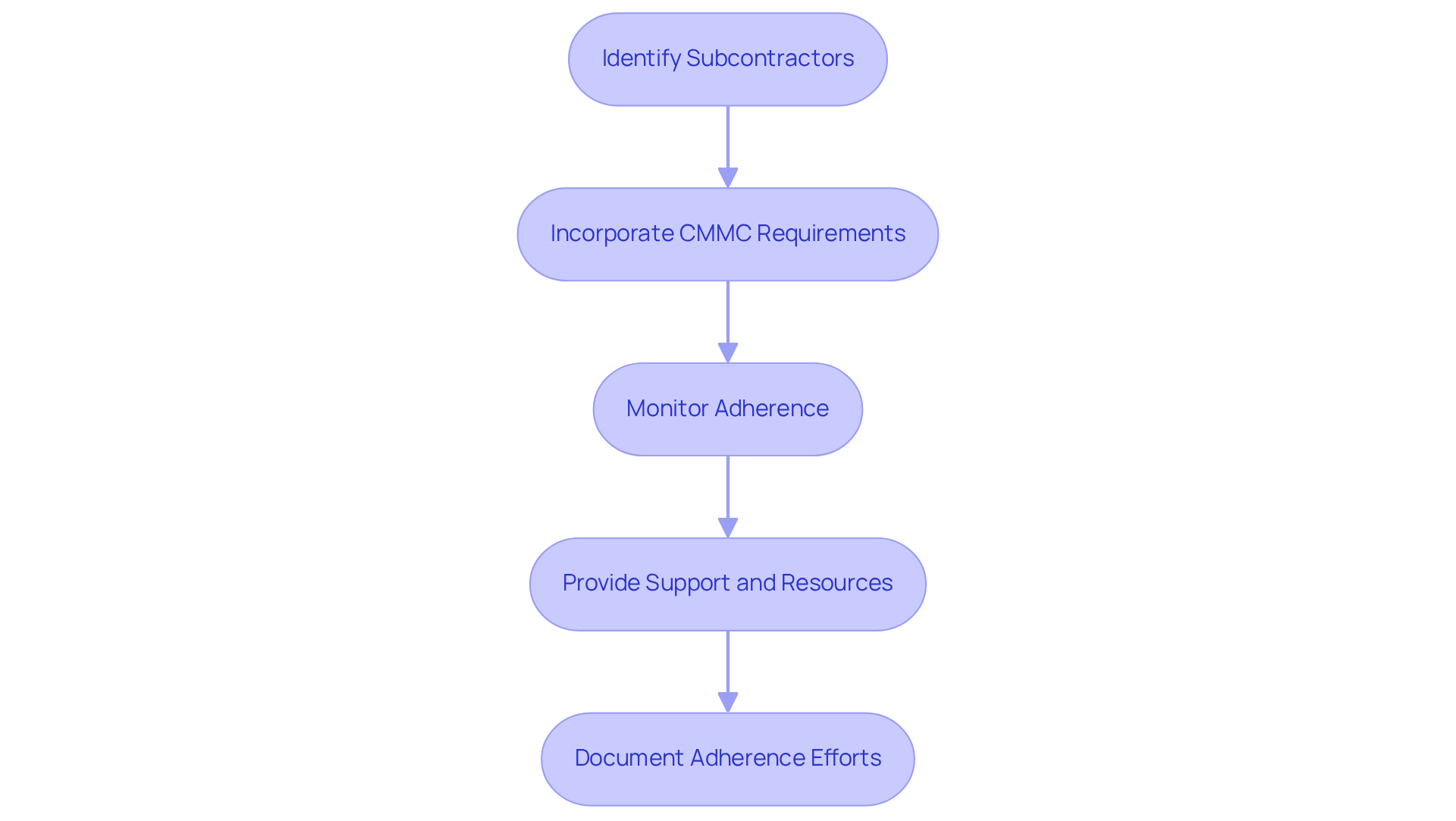
Flow-down requirements are critical obligations that primary builders must enforce with their subcontractors to ensure compliance with cybersecurity standards. Under the Cybersecurity Maturity Model Certification (CMMC), primary vendors are responsible for ensuring that any subcontractor managing Federal Contract Information (FCI) or Controlled Unclassified Information (CUI) meets the required CMMC level specified in the agreement.
- Identify Subcontractors: Determine which subcontractors will have access to sensitive information and evaluate their current adherence status. Failure to ensure subcontractor compliance can lead to significant risks for the prime contractor.
Incorporate CMMC requirements for defense contractors in contracts by ensuring that all agreements with subcontractors explicitly include adherence to these requirements. This should detail the level of certification required and the specific responsibilities of the subcontractor, including adherence to DFARS 252.204-7012 and NIST 800-171 standards.
- Monitor Adherence: Establish a robust process for monitoring subcontractor adherence. This may involve regular audits, reviews of security practices, and ensuring that subcontractors are prepared for their own assessments. Verification of subcontractor progress can include reviewing Supplier Performance Risk System (SPRS) scores and internal assessments. Without proper oversight, the integrity of the entire contract may be compromised.
- Provide Support and Resources: Offer guidance and resources to subcontractors to help them meet requirements. This might mean sharing best practices, offering training, or helping with gap assessments. Setting expectations early and referring subcontractors to experienced partners can prevent delays during assessments.
- Document Adherence Efforts: Maintain thorough documentation of all adherence efforts related to subcontractors. This documentation is vital for audits to prove due diligence. A supportive official within the service provider's organization must finalize an annual affirmation of ongoing adherence for each unique identifier (UID) in the SPRS.
By comprehending and overseeing flow-down requirements, primary vendors can guarantee that their entire supply chain adheres to the CMMC requirements for defense contractors, thereby protecting sensitive information and preserving eligibility for Department of Defense contracts. Ultimately, the responsibility for compliance rests with the prime contractors, making diligent oversight of subcontractors not just advisable, but essential.
Conclusion
The CMMC is not merely a regulatory framework; it is a vital component in securing national interests and ensuring the integrity of defense operations. Understanding and implementing these requirements goes beyond regulatory obligations; it is essential for safeguarding national security and maintaining the integrity of the defense industrial base. As the landscape of cyber threats evolves, compliance with CMMC is becoming increasingly essential for all contractors involved in federal contracts.
Key insights from this guide highlight the urgency for defense contractors to familiarize themselves with the CMMC compliance levels, which range from foundational to expert requirements. Each level necessitates specific security controls and assessments that are crucial for achieving certification. Many contractors face significant unpreparedness for the upcoming deadlines, which poses a significant risk to their competitive standing. By leveraging resources such as Koop Technologies, contractors can streamline their compliance processes, ensuring they meet the necessary standards effectively and efficiently.
Given these challenges, defense contractors must act decisively. Implementing robust compliance strategies, conducting thorough assessments, and ensuring subcontractor adherence are essential steps in navigating the complexities of CMMC. A proactive approach to compliance is crucial for maintaining contract eligibility and securing sensitive information. Embracing these requirements not only positions contractors for success but also fortifies the defense sector against emerging cyber threats, underscoring the critical importance of CMMC compliance in today's defense landscape. Ultimately, the commitment to CMMC compliance will define the future landscape of defense contracting and national security.
Frequently Asked Questions
What is the Cybersecurity Maturity Model Certification (CMMC)?
The CMMC is a set of requirements for defense contractors to secure sensitive information, including Controlled Unclassified Information (CUI) and Federal Contract Information (FCI), and is necessary for qualification in DoD contracts.
Why is the CMMC important for defense contractors?
The CMMC is crucial for safeguarding sensitive data and maintaining eligibility for DoD contracts, especially in light of escalating cyber threats. Non-compliance can lead to disqualification from bidding on contracts.
What is the deadline for compliance with CMMC requirements?
All DoD agreements exceeding the micro-purchase threshold will require compliance with CMMC requirements by November 10, 2028, with phased implementation beginning on November 10, 2025.
What challenges do defense contractors face regarding CMMC compliance?
Many contractors are struggling to achieve compliance, with nearly 80,000 expected to require Level 2 certification, while only about 200 firms have been evaluated, highlighting the urgency and complexity of meeting these regulations.
How does Koop Technologies assist with CMMC compliance?
Koop Technologies offers a Regulatory Database that catalogs regulations and provides advanced filtering options and alerts for changes, along with Requirements Management solutions that help vendors monitor adherence status and manage third-party risks.
What are the implications of failing to comply with CMMC standards?
Contractors that fail to comply with CMMC standards risk disqualification from bidding on DoD contracts, which underscores the necessity for them to understand and apply these requirements.
How does CMMC compliance affect the defense industrial base?
CMMC compliance is vital for the integrity of the entire defense industrial base, ensuring that sensitive information is adequately protected against rising cyber threats.

